antibiotic -- appetite -- diabetes -- iron --
inflammation -- brain development -- weight loss --
diuretic, detoxifying -- bones -- liver --
gastrointestinal -- fatigue, lack of energy -- oral
cavity -- muscle pain - stimulating sexuality --
metabolism
by Michael Palomino NEVER VACCINATE, Jan 18, 2023 -
translation May 6, 2023
-- antibiotic effect in the oral cavity and urinary tract
- antibiotic effect in the whole body when the tea is
taken (let infuse for 5 min) [web01]
-- appetite stimulant [web01]
-- reduces respiratory infections (cough, cold, common
cold) and respiratory problems (asthma, sore throat):
Cress alone or puree with cress+honey [web04]
-- strengthens eyes with vitamin A for the eyes when they
must see in the dark [web04]
-- diabetes is reduced [web02], reduces the disposition to
diabetes ("prediabetes") with vitamin K, improves insulin
sensitivity, lowers blood sugar levels [glucose] [web04]
-- iron: causes the formation of iron for the blood
[web02]
-- inflammation of the urinary tract [web01],
-- inflammations in general, has an antibiotic effect (as
tea, let infuse for 5 min.) [web01],
-- reduces inflammation with omega-3 fatty acids and is
prevention against chronic inflammation [web04].
-- brain development: iodine for thyroid develops the
formation of thyroxine+more energy for brain development
[web02]
-- weight loss [web02]
-- diuretic, detoxifying [web01,web02]
-- skin care with vitamin C: for collagen formation,
against brittle and vulnerable skin [web04]
-- Heart: strengthens the heart with omega-3 fatty acids
against harmful omega-6 fatty acids [web04]
-- Immune system: increases T-helper cells, this is a
general prevention against diseases [web04]
-- Bone promoting: lots of VitC+calcium + iodine for
thyroid provokes the formation of thyroxin+more energy,
this promotes bone formation [web02]
-- reduces cancer vulnerability with vitamin A [web04]
-- liver promoting [web01]
-- gastrointestinal [web02]
-- Fatigue, lack of energy: iodine for thyroid provokes
the formation of thyroxine+more energy [web02]
-- Oral and mouth: has antibiotic effect in food [web01]
-- Muscle pain [web02]
-- Sexuality stimulating (aphrodisiac): Iodine for thyroid
provokes the formation of thyroxine+more energy for
beautiful sex life [web02]
-- Metabolism: iodine for thyroid provokes the formation
of thyroxine+more energy for metabolism [web02]
-- for birth contracions: garden cress has a
labor-inducing effect, so take garden cress before giving
birth [web04]
-- garden cress is also for wound healing with vitamin C:
for collagen formation, injuries and wounds heal faster
[web04]
[web01] Garden cress is a well-known herb
(orig. German: Gartenkresse ist ein altbekanntes
Gewürzkraut):
https://www.gartenschlumpf.de/gartenkresse/
[web02] Garden cress (Lepidium) (orig. German:
Gartenkresse (Lepidium):
https://supernahrung.com/gartenkresse/
[web04] Cress: 4 healthy effects, 4 risks + 4 tips for
planting (orig. German: Kresse: 4 gesunde Wirkungen, 4
Risiken + 4 Tipps zum Anpflanzen):
https://www.gesundfit.de/artikel/kresse-17276/
Warnings
-- Garden cress has a diuretic effect and you should
expect to go to the bathroom some times a day [web04]
-- Garden cress induces birth contractions and can
cause miscarriage in pregnant women, so DO NOT take
garden cress if pregnant [web04]
-- Excessive consumption of garden cress can interfere
[block] with the iodine uptake by the thyroid gland
and cause goiter [web04]
Garden cress data: Cultivation - healing
effect - kitchen: Garden cress is a well-known spice herb
(orig. German: Gartenkresse ist ein altbekanntes
Gewürzkraut)
https://www.gartenschlumpf.de/gartenkresse/ [web01]
diuretic, detoxifying -- inflammation --
promotes appetite -- antibiotic in the mouth -- liver --
as tea: antibiotic effect
-- the garden cress probably comes from Iran, is common
since the antiquity in Europe and in Asia, but is replaced
on some markets by the watercress
-- for medicinal purposes the garden cress is already
mentioned by Hippocrates and by Galen.
The cultivation of garden cress
Translation: "During pre-germination, the seed must stand
in the dark. After 3-4 days, put the small plants into the
light and preferably cool, then they get the best taste.
In the garden, cress seeds can be sown in a bed in the sun
or partial shade, one can begin in March."
Translation: "However, cress can also be sown on damp
absorbent cotton."
-- in the germination period always keep the soil moist,
on the windowsill use normal potting soil, no fertilizer,
in the garden outdoors sow it in medium garden soil and
water it well when there are dry conditions
-- if you always want to have cress available, you have to
reseed every 2-3 weeks
-- garden cress can be grown in the garden or on the
windowsill, and for healings the bitter flowering plant is
used
-- garden cress grows up to about 30 cm high, is annual
-- garden cress consists of branched stems with lobed
leaflets, the small flowers are white or reddish, the
seeds are reddish-brown in small pods
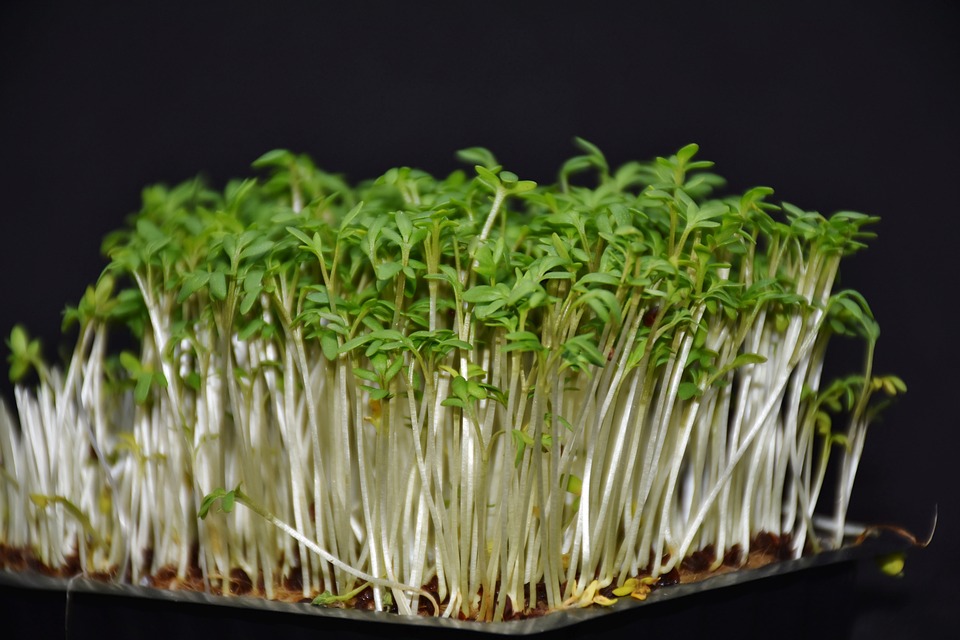
-- seedlings of garden cress have 3-lobed cotyledons (seed
leaflets), the adult leaves are incised (have cuts), both
are edible
-- flowers bloom outdoors in June and July in small
umbels, the whole plant then smells spicy
-- Buy cress seeds every year -- garden cress contains
many vitamins -- outdoor cress sometimes has pests on it,
e.g. earth fleas, or germination mold, then you have to
throw away the plant, garden cress on the windowsill lives
only a short time and is hardly attacked by pests --
garden cress germinates quickly and is available for the
kitchen after 8 to 14 days, in boxes, pots, bowls -- you
sow the cress in a dark place all year round in the
house, in the open field from March -- the soil must
be kept moist, or you sow on damp cotton wool in a shallow
bowl or in a plate, always keep moist -- cotyledons (seed
leaves) often still have seed coats on them, which you
have to pull or brush off, the cotyledons (seed leaves)
are for seasoning (flavoring), best taste is given with a
few days in a light + cool location -- the leaves are for
the salad.
Ingredients of garden cress
-- high content of vitamins A and C, essential oil
Healing effects of garden cress
-- use flowering plants: The flowering garden cress
tastes bitter and is used for medicinal purposes,
for example as a healing tea
-- has a diuretic [detoxifying] effect, against
inflammation of the urinary tract
-- stimulates appetite
-- is antibiotic against inflammation in the oral
cavity
-- supports the liver
as a tea
-- as a tea, garden cress develops the antibiotic
benzyl mustard oil [against bacteria, viruses,
fungi]
-- Garden cress + honey in hot water = cough tea
Garden cress in the kitchen
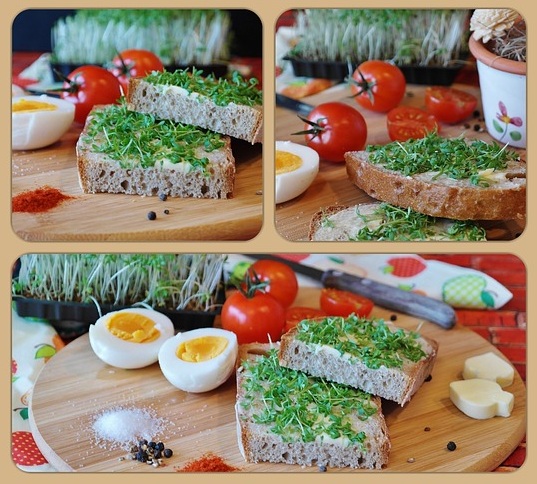
-- for seasoning (flavoring) and on sandwiches, use
the [cut] seedlings of the garden cress with the
cotyledons (seed leaves)
-- the adult leaves of the garden cress are added to
salads.
Iron for the blood - diabetes - weight
loss - antibiotic - diuretic cleansing - bones - vitamin
C - good feeling and energy - metabolism - brain
development - gastrointestinal - muscles - muscle pain -
stimulates sexuality (aphrodisiac).
Summary:
Shape of garden cress, origin - raw food,
tea and seeds.
-- garden cress (lat. Lepidium) grows in erect, bare stems
up to 40cm high, is annual, flowering time in the garden
outside is from June to August
-- comes from India to Arabia and spread over Persia to
Europe
-- light green leaves, often somewhat bristly hairy
-- raw on the bread slice, in soups, as a decoration
-- as tea in hot water, let infuse for 5 minutes, drink
-- seeds are bought in the garden center, health food
store or supermarket
-- using the seeds: Crush the seeds in a mortar, then make
a tea with them, drink it.
Ingredients of garden cress
To give a brief overview of the ingredients of garden
cress, the information is based on 100 grams.
The garden cress has about 38 calories and 1.5g fat.
Furthermore, the plant has a particularly high amount of
folic acid - about 110 micrograms. Vitamins B, C and K are
also a component of cress, as well as potassium, calcium,
magnesium and iron.
Garden
cress: with
vitamins,
minerals and
trace elements
(Since this is a
natural product,
these values may
differ slightly).
Ingredient
per 100g / 100 ml
NRV¹)
NRV=Nutrient Reference
Values"
(Recommended Daily Intake
of nutrients)
-- numerous studies confirm the healing effects of garden
cress
-- taking at least 1 teaspoon per day gives positive
effects, studies say that 1 gram daily is already enough
to achieve healing effects
-- the healing effect comes with regular intake in 3 to 12
weeks - the more vitamins are missing in the patient, the
longer the healing takes
-- the application of garden cress must be done
immediately after harvesting [shortly after cutting],
because already after 30 minutes valuable vital substances
are broken down and vitamins are lost
-- taken raw is best
Quote (translation): "In principle, it is important with
the cress that it is consumed immediately after
harvesting. This is because after just a good half an
hour, the harvested plant breaks down its valuable vital
substances and loses healthy vitamins. In addition, it is
advisable to ingest that plant in raw form."
-- this intake of garden cress causes the first positive
effects in 3 to 12 weeks, which depends on the vitamin
deficiency of the patient person: "The more vitamins are
missing, the longer it also takes to rebuild the vitamin
deposits."
Rebuilding of the blood
-- Garden cress contains iron for blood formation
Circulation and blood flow
-- the ingredients of garden cress enlarge the blood
vessels [arteries+veins], stimulating blood flow [to the
last capillary]
-- so the whole body becomes warm + is prevention against
calcification in arteries and veins
-- this is prevention against heart attacks and strokes
Diabetes
-- diabetes: blood sugar [glucose] is lowered
-- diabetes: garden cress with chromium improves the
supply of sugar to the cells, this is prevention against
diabetes + regulates cholesterol levels
Weight loss
-- Garden cress with chromium regulates hunger with a long
feeling of having no hunger (satiety)
Antibiotic effect of garden cress
-- garden cress with mustard oils have antibiotic effect
against bacteria, viruses and fungi + immune system is
strengthened
-- mustard oils have antibiotic effect on kidneys and
bladder, prevention of pathogens in urinary tract,
prevention of urinary tract infections
-- the mustard oils have diuretic action [garbage and
toxics in the body are eliminated].
Garden cress for bones
-- garden cress contains a high content of vitamin C for
bones and connective tissue
-- garden cress contains much calcium for the bones
-- iodine for the thyroid gland causes in the thyroid
gland the production of the metabolic hormone thyroxine,
so that more energy is available in the body and bone
formation is promoted
Garden cress with vitamins
-- high content of vitamin C for bones and connective
tissue
-- the combination of vitamins in garden cress gives
an effect of good feeling and more energy
Garden cress for metabolism
-- garden cress contains iodine, which stimulates
metabolism, which is lead to the thyroid gland so that
the thyroid gland can produce the metabolic hormone
thyroxine
-- this provokes more energy in the body + more bone
formation + more brain development.
Gastrointestinal - muscles - sexual organs
-- the healing art of India [Ayurveda] has been using
the healing powers of garden cress for thousands of
years: against stomach problems, against muscle pain,
as an aphrodisiac
-- also in Europe the experience is valid: sexual
unwillingness is reduced by garden cress
Garden cress in the kitchen
-- garden cress as a topping on a slice of buttered
bread
Warnings
-- Consumed in large quantities, garden crass can provoke
irritation of the gastric mucosa, prevention: drink plenty
of water when taking it
-- Contact allergies of the skin to mustard oils: redness,
rash, itching
Similar medicinal plants to garden cress
-- Eucalyptus (among others against diabetes)
-- St. John's wort (among others against Diabetes)
-- Mugwort (Artemisia vulgaris - increases blood
circulation, against diabetes etc.)
-- Bean shells (increase blood circulation, against
diabetes, etc. )
-- Nettle (quickly saturates against excess weight)
-- Elderberry (quickly saturates against excess weight)
-- Chamomile (good feeling and energy)
-- Melissa balm (good feeling and energy)
Garden cress chopped on buttered bread, in
cream cheese, cottage cheese, etc. [web03] Garden cress
from Mossad Wikipedia:
https://de.wikipedia.org/wiki/Gartenkresse [web03]
Summary:
-- garden cress probably comes from the Near East and is
an annual plant [must be reseeded each spring].
-- garden cress seeds were already found in Egyptian
pharaoh tombs
-- garden cress can be sown and allowed to grow on
cultivation fleeces, is easy to cultivate
-- garden cress raw tastes slightly spicy, something like
mustard, radish
Preparation
-- mostly the sprouts are eaten 1 week after sowing, cut
and then put on a slice of bread, in cold spreads, in
cream cheese, in cottage cheese, in salads, in soup, in
egg dishes, as a decoration.
-- garden cress is used in the Frankfurt Green Sauce and
in more dishes
Ingredients
-- much Vit. C, iron, calcium, folic acid, Vit. B, is
ideal in winter as a food supplement
-- the flavor substance isothiocyanate (benzyl
isothiocyanate) is formed from a mustard oil glycoside:
glucotropaeolin
Garden
cress for eyes, skin, immune system, heart,
contractions, wound healing, etc. [web04]
Cress: 4 healthy effects, 4 risks + 4 tips for
planting
(orig. German: Kresse: 4 gesunde Wirkungen, 4
Risiken + 4 Tipps zum Anpflanzen)
https://www.gesundfit.de/artikel/kresse-17276/ [web04]
strengthens eyes - skin - immune system -
heart - labor - wound healing - reduces respiratory
infections, diabetes, inflammation, susceptibility to
cancer - paste for the skin + chapped lips Marie Nadine Volz (specialized
editor)
Summary:
-- Garden cress probably originates from the Middle
East and Egypt, is cultivated worldwide, with a focus
on Holland, England and France
-- Garden cress is a mustard plant, tastes spicy,
contains important nutrients, supports the immune
response and the prevention of diseases
Nutritional values of garden
cress
quantity per 100 grams
Calories
38 kcal
Protein
1,5 g
Fats
4,2 g
Carbohydrates
1,8 g
from this 1,4 g is sugar
Foic acid
0,11 mg
Vitamin K (only in watercress)
0,25 mg
Potassium
550 mg
Calcium
214 mg
Magnesium
40 mg
Iron
290 mg
Vitamin C
59 mg
-- Vitamina A, C,
K
-- Omega-3 fatty acids
Intake
-- chew raw
-- mash
-- mash and mix with honey
Healing properties
-- strengthens the eyes with vitamin A for vision in
the darkness
-- for skin care with vitamin C: for collagen
formation, against brittle and vulnerable skin
-- strengthens the immune system: increases T-helper
cells, it's really a disease prevention
-- strengthens the heart with omega-3 fatty acids
against harmful omega-6 fatty acids
-- for birth contractions during childbirth: garden
cress induces birth contractions, so take garden
cress before childbirth
-- for wound healing with vitamin C: for collagen
formation, injuries and wounds heal faster
-- reduces respiratory infections (cough, cold,
common cold) and respiratory problems (asthma, sore
throat): Cress alone or mix cress+honey as a puree
-- reduces disposition to diabetes ("prediabetes")
with vitamin K, improves insulin sensitivity, lowers
blood glucose levels
-- reduces inflammations with omega-3 fatty acids
and is a prevention against chronic inflammation
-- reduces susceptibility to cancer with vitamin A
Skin care with garden cress
-- garden cress seeds in water and honey result in a
thick paste that works on the skin: for sunburn,
irritated skin, dry skin, chapped lips
-- Garden cress is safe for pets.
Warings about garden cress
-- Garden cress has a diuretic effect and one must
expect to go to the toilet sometimes
-- Garden cress induces birth contractions and can
cause miscarriage in pregnant women, so DO NOT take
garden cress if pregnant
-- Excessive consumption of garden cress can
interfere [block] the iodine uptake by the thyroid
gland and cause goiter.
Videos
Video: Cultivating garden cress in a bowl
with paper towels+water [web05] Grow cress yourself (orig.
German: Kresse selber anbauen)
Video on YouTube:
https://www.youtube.com/watch?v=sEQCGCqhSf8 [web05]
https://www.youtube.com/watch?v=sEQCGCqhSf8 -
YouTube channel: EvaMarbachVerlag
- uploaded on Feb 16, 2016
-- you buy the cress seeds in the DIY market or
supermarket or in the Internet (27'') -- in a plastic bowl
3 sheets of kitchen paper are laid out, the kitchen paper
is folded and cut, (52'') -- press the paper into the tray
and pour 1-2mm of water over it (1'5'') -- sprinkle the
cress seeds evenly into the water (1'10'') -- let the
cress seeds swell and rise and give them water daily
(1'26'') -- after 6 days the cress is big enough to
harvest, cut it off with scissors (1'45'') -- after
cutting, the cress will continue to grow for a few days
(1'50'')
Video comments and answers about growing cress
-- cress does not grow back permanently and grows back
only partially, when the growth stops you have to reseed
-- you can let the cress grow, then it will form flowers,
and when the flowers are pollinated, new seeds will form
by themselves -- water 2x a day to keep the kitchen paper
moist, there should be no water in the tray [after
germination] -- cress does not need much light, on the
windowsill is enough -- recycled kitchen paper may contain
toxins, so always use regular kitchen paper, street dust
is more toxic than kitchen crepe -- mold on the bottom can
have numerous causes: too little ventilation from too
close planting, too little air movement at the site, too
many mold spores in the air, high humidity, or if you
don't harvest the cress during a long time, it will
eventually provoke mold formation -- all cress grows fast,
it doesn't depend on the brand -- there are extra "cress
plates" from the company "GREEN EARTH" with water grooves
for optimal watering of the cress -- in summer the cress
germinates faster than in winter -- older seeds take
longer to germinate than fresh seeds -- the brighter, the
better the cress grows -- recycled paper contains toxic
printing ink -- the cress seeds then consume the water or
the water also evaporates
-- sowing on earth soil, growth takes about the same
amount of time -- the seeds are edible, but don't taste
good -- garden cress can be grown indoors, not just in the
garden -- the cress sprouts get their energy from the seed
and don't need soil, the water on kitchen paper is enough
-- shallow glass dish works too -- it has to be a paper
that absorbs liquid, toilet paper should work -- sprouts
use the nutrients of the seeds, only then those of soil
Growing cress on cotton wool or kitchen
paper [web06]
Growing Cress with Cotton Wool - ULTIMATE GUIDE: How to
Sow, Plant & Harvest Garden Cress Seeds???
(orig. German: Kresse Anbauen mit Watte - ULTIMATIVE
ANLEITUNG: Wie Gartenkresse Samen Säen, Pflanzen &
Ernten???)
https://www.youtube.com/watch?v=k5c9kQoKqdA [web06]
Video: Growing Cress with
Cotton Wool - ULTIMATE GUIDE: How to Sow,
Plant & Harvest Garden Cress Seeds???
(2'50'') (orig. German: Kresse Anbauen mit Watte -
ULTIMATIVE ANLEITUNG: Wie Gartenkresse Samen
Säen, Pflanzen & Ernten???)
Video: Growing Cress with Cotton Wool -
ULTIMATE GUIDE: How to Sow, Plant &
Harvest Garden Cress Seeds??? (2'50'')
https://www.youtube.com/watch?v=k5c9kQoKqdA
- YouTube channel: ProblemLöserTV
- uploaded on July 13, 2020
-- take a plate and put cotton wool or 3 layers of
kitchen paper in it, sprinkle the seeds on it and place
the plate in a place above 15 degrees with light or
partial shade (1'15'') -- direct sunlight dries out the
base too quickly (1'23'') -- the cress is sprayed with
water several times a day with a spray bottle, and after
4 days you can see the green cress growing (1'43'') --
after 7 days you can cut off the green part of the cress
with scissors ( 2'5'') -- there are funny cress plates
in hedgehog shape (2'20'')