from Facebook: On the track of truth (Der Wahrheit auf der
Spur); May 2, 2013;
https://www.facebook.com/derwahrheitauf.derspur (in 2020 no
access any more)
but has got another place:
https://www.facebook.com/groups/1720841941507974/
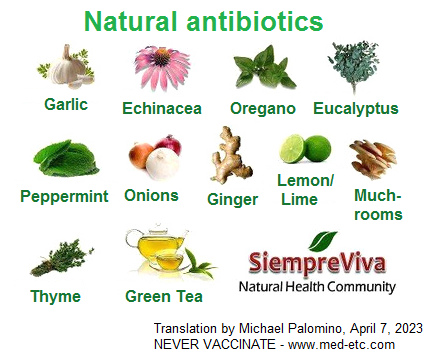
Natural antibiotics: garlic, echinacea, oregano, eucalyptus,
peppermint, onions, ginger, lemons / limes, mushrooms, thyme,
green tea - and missing in the photo: honey and horseradish
[1]

7.4.2019: Natural antibiotics from fungi
against bacteria - AND may be also against viruses:
A wide, so far little explored field! The unexpected
magic of mushrooms - even mushrooms as a source of
antibiotics!
https://netzfrauen.org/2019/04/07/mushrooms/
-- Fungus records: Canadian researcher find 2 giant fungus
Armillaria gallica (honey mushroom) in Crystal Falls
(Michigan, "USA") and in Oregon ("USA")
-- Antibiotics are produced with substances from fungi
-- Penicillin is produced from household mold growing on
old bread
-- Substances from fungi are healing flu, polio,
mumps, measles and glandular fever, also "incurable
diseases" like HIV and the Zika virus: Armillaria gallica
-- Substances from fungi eat up plastic:
Aspergillus tubingensis
-- Substances from fungi for building materials,
mushroom bricks, intelligent concrete that repairs cracks
itself, alternative wood etc.: Trametes versicolor
The article:
Normally fungi are associated with rot and decay. They can
also be a disregarded resource that helps humanity solve
some of its biggest problems. Mrs. Stella McCartney, for
example, is among the designers who now want to work with
mushroom leather. Or, the fungus called "Armillaria
gallica" could offer a potential counterweight to cancer's
notorious instability. And even mushroom packaging exists.
It's biodegradable and is already being used by companies
like Dell to package their computers. Researchers at Yale
found that there is a rare fungus that likes to eat
plastic (link).
And there are even already solutions for bee mortality (link),
and there are special fungi for this too (link).
You will be surprised. Learn here the unexpected magic of
mushrooms.
[Fungus records: Armillaria Gallica (honey
mushroom) in Michigan and in Oregon]
The unexpected magic of fungi
We had already introduced you Mr. Paul Stamets (link).
He holds several patents on natural insecticides made from
mushrooms. Mushrooms belong to the future, says Paul, and
he show us this following article, which we have
translated for you.
They are usually associated with rotting and
decay: fungi. But they could also be a disregarded
resource that helps mankind to solve some of their biggest
problems.
Mr. Jim Anderson is standing on a monster. It is living
since a long time already, when king Xerxes was
organizning wars against the ancient Greeks, and the
weight of this monster is more than three blue whales
together. The monster's appitite is never finishing and
it's growing passing the giant forest lines. But this is
not a lost animal of Greek mythology, but this is a
fungus.
Mr. Anderson is standing next to a modest piece of forest
land in Crystal Falls, in Michigan
on the Upper Pensinsula. He is visiting an organism whic
his living in the forest's floor and which was detected by
him and his friends almost 30 years ago. This is the
home of "Armillaria gallica", a kind of honey mushroom.
Anderson stands in a modest piece of forest land in Crystal
Falls, on Michigans Upper
Peninsula. He pays a visit to an organism that lives in
the forest floor and which he and his colleagues
discovered almost 30 years ago. This is the home of
Armillaria Gallica, a kind of honey mushroom.
These ordinary fungi occur in moderate forest areas
throughout Asia, North America and Europe, where they grow
on dying or dead wood, and the fungus is acceleratig the
rotting process. The only visible signs of it are often
lumps of scaly yellow-brown poisonous mushroom-like fruit
bodies that are up to 10 cm in size.
When Anderson and his colleagues came to Crystal
Falls at the end of the 1980s, they found that the
previously suspected rich accumulation of Armillaria
Gallica under the mulch of leaves and the top layer of the
forest was actually a single gigantic specimen. They
suspected that the mushroom expanded over around 0.37 km2,
had 100 tons of weight and was at least 1,500 years old.
It became the latest record holder for the largest
organism on our planet. A copy of the same kind can be
found in a forest of Oregon which keeps the
current record.
"At that time, this caused some surprise," says Anderson.
“Our article was released on April 1, and some considered
the news an April fool's joke. In 2015 we wanted to see it
again [the mushroom] for controlling our prediction that
this organism was really independent and permanent ”.
Between 2015 and 2017, they returned to it several times,
removed samples from distant points in the forest and let
their DNA run through a sequencer of their laboratory at
the University of Toronto. The genetic analysis has
developed significantly since her first study in the
1980s. New techniques accelerate the process, reduce costs
and offer more information.
The new probes showed that the Armillaria Gallica, which
they had identified as an independent being, was much
larger and older than predicted, four times as large and
another 1000 years older and with about 400 tons of weight
(link).
The analysis showed another, more amazing recognition, one
that could support us humans in our struggle against one
of the greatest enemies of modern medicine - cancer.
The Canadian researchers discovered the possible secret
behind Armillaria Gallica's extraordinary dimension and
age. It comes to light that the fungus has an extremely
low mutation rate - which means that it avoids possible
harmful changes in its genetic code.
When organisms grow, every cell is parting into two for
producing daughter cells. By the time, DNA in the cells
can be damaged provoking mistakes which is known as
mutations which are introduced into the genetic code. This
is considered one of the key mechanisms for aging.
But it seems that the fungus "Armillaria Gallica" in
Crystal Fall could have a certain automatic resistence
against this DNA damage. 15 probes from parts far away in
the forest which were controlled by the team in sequences
had only 163 letters changed from 100 millions in the
genetic code of "Armilaria gallica".
"The frequency of mutation is much, much lower than we
could ever have imagined," says Mr. Anderson. “In order to
achieve this low level of mutation, we expect the cells to
share on average once per meter. But the amazing thing is
that the cells are microscopically small - only a few
micrometers in size - so that millions of them would be
needed in every meter. ”
Anderson and his team believe that the mushroom has a
mechanism that helps to protect his DNA from damage by
giving it to one of the most stable genomes in the natural
world. Although you still have to deal with this, the
remarkable stability of the genome of the Armillaria
Gallica could provide new knowledge of human health.
In some types of cancer, mutations in cells can "riot" (link)
because the normal repair mechanisms of the cells
controlling the DNA are not working any more.
"Armillaria Gallica could offer a potential counterweight
to the notorious instability of cancer," says Anderson.
“If you see a line of cancer cells that are equivalent in
old age, they would be full of mutations, so they are not
reckognizable possibly. Armillaria is the other extreme.
It could be possible to recognize the evolutionary
changings which makes possible to be [like the cell is]
comparing it with cancer cells."
it would be so sifted by mutations that you may not be
able to recognize it. Armillaria is the opposite extreme.
It could be possible to recognize the evolutionary changes
that made it possible for her to be [as she is] and to
compare them with cancer cells. "
This could not only enable scientists to learn more about
what is going wrong in cancer cells, but also open up new
opportunities for cancer treatment.
While Anderson and his colleagues do not plan to do this
work themselves - they leave them to others who are
younger and more qualified to understand the genetic
complexity of cancer - their results offer a fascinating
insight into the unused power of fungi which could help
mankind.
Fungi are among the most common organisms on our
planet - the combined biomass of these often tiny
organisms exceeds all animals on the planet (link).
And we constantly discover new mushrooms. More than 90% of
the estimated 3.8 million fungi in the world are currently
[still] unknown to science. In 2017 alone, 2,189 new fungi
types were described by scientists (link).
A recently published report by the British Royal Botanic
Kew Gardens in London emphasizes that mushrooms are
already used in hundreds of different types, from paper
production to cleaning our dirty dresses (link).
[The pharmaceutical antibiotics are
made of substances of fungi]
Fungi as a source of antibiotics
Around 15% of all vaccines and biologically produced
medication come from fungi. The complex proteins, for
example, triggered an immune response to the hepatitis B
virus, grow in yeast cells that belong to the mushroom
family.
Perhaps the best known is the antibiotic penicillin, which
was discovered in a frequent type of household mold that
often grows on old bread. Dozens of other types of
antibiotics are now produced by mushrooms.
They also offer numerous treatments of migraines and
statins for the treatment of heart disease. A relatively
new immunosuppressant for the treatment of multiple
sclerosis was developed from a connection that is produced
by a mushroom, which itself was infecting cicada larvae.
"It is part of this family of fungi that penetrate insects
and eat them," says Mr. Tom Prescott, a researcher who
evaluates the use of plants and mushrooms in the Royal
Botanic Kew Gardens [in London]. "They produce these
compounds to suppress the insects's immune system, and it
turns out that they can also be used in humans."
[Substances from fungi are healing many
diseases]
Some researchers, however, are reporting that so far
we have only scratched the surface of what fungi can
offer us.
"It has already been reported that [fungi] become
active against viral diseases," says Riikka
Linnakoski (link),
a forest pathologist at the Natural Resources
Institute, Finland.
Compounds produced by fungi can destroy viruses that
cause diseases such as influenza, polio, mumps,
measles and glandular fever. Numerous fungi have
also been found to produce compounds that could
treat diseases that currently have no cure, such as
HIV and the Zika virus (link).
"I think these represent only a small fraction of
the total arsenal of bioactive compounds,"
Linnakoski says. "Fungi are a huge source of
different bioactive molecules that could potentially
be used as antiviral agents in the future."
She is a member of a research team investigating
whether fungi growing in Colombia's mangrove forests
could be sources of new antiviral agents. However,
those goals have not yet been reached. Fungi as a
source of antibiotics that work against bacteria
have been well studied, but fungi antibiotics
against viruses are not approved yet.
Linnakoski has two ideas why science has no research
performed with fungi antibiotics against viruses,
first they did not cultivate fungi and recollecting
them, and second there is no communication between
mycologists and virologists. But she believes it
will only be a matter of time before a fungus-based
antiviral drug finds its way into the clinic.
Linnakoski also believes that new classes of fungi
can be found in inhospitable environments, for
example on the sea floor in the deepest parts of the
oceans, or in the mangrove forests where the
conditions are special, so it would be possible to
find new interesting compounds.
"It can be assumed that the extreme conditions
encourage fungi to produce unique and structurally
unique secondary metabolic products," she says.
"Unfortunately, many of the native ecosystems are
disappearing in alarming speed, which are hosts for
a great potential for the discovery of new bioactive
connections, such as mangrove forests, in alarming
speed." [...]
[Fungi eat plastic]
In addition, mushrooms have uses
that can solve other problems – beyond our
health.
A fungus found in the ground at a landfill on the
outskirts of Islamabad, Pakistan, may be a solution
to the alarming amount of plastic pollution clogging
our oceans. Fariha Hasan, a microbiologist at
Quaid-I-Azam University in Islamabad, found that the
fungus Aspergillus tubingensis can quickly degrade
polyurethane plastic.
A fungus found in the ground at a landfill on the
outskirts of Islamabad, Pakistan, may be a solution to the
alarming amount of plastic pollution clogging our oceans.
Fariha Hasan, a microbiologist at Quaid-I-Azam University
in Islamabad, found that the fungus Aspergillus
tubingensis can quickly degrade polyurethane
plastic (link
ENGL).
These plastics, which used to be used to make a wide range
of products such as furniture foams, electronics housings,
adhesives and films, can remain in soil and seawater for
years. However, it has been found that the fungi break
them down within a few weeks. Hasan and her team are now
investigating how the fungi can be used for the
large-scale mining of plastic waste. Other fungi such as
Pestalotiopsis microspore, which usually grows on rotting
ivy leaves, have also been found to have a tremendous
appetite for plastic (link ENGL),
raising hopes that they could be used to solve our growing
waste problem.
In fact, mushrooms have a significant flavor for the
pollution we burden our world with. Species have been
discovered that can clean soils of oil spills, break down
harmful heavy metals, destroy long-lived pesticides (link
ENGL), and even help rehabilitate more radioactively
contaminated sites (link
ENGL).
However, mushrooms could also primarily
contribute to the fact that some plastics no longer
have to be used at all.
A number of groups around the world are now trying to use
an essential feature of fungi – the vein-like webs of
mycelium they produce – to create materials that can
replace plastic packaging. As fungi grow, these mycelium
threads branch outward to probe into nooks and crannies in
the soil, thus connecting it. They are nature's glue.
In 2010, Ecovative Design began to investigate how they
could use it to combine natural waste products such as
rice husks or wood chips into an alternative to
polystyrene packaging. Her early work has evolved into
MycoComposite, which uses leftovers from hemp plants as a
feedstock.
These are packaged together with fungal spores and flour
in reusable molds, in which they then grow for nine days.
In the process, they produce enzymes that begin to digest
the waste. Once the material has been shaped into the
desired shape, it is heat treated to dry the material and
stop further growth.
The resulting "mushroom packaging" (link ENGL) is
biodegradable and is already being used by companies such
as Dell to package their computers.
The company has also developed a method to grow mycelium
in foam form that can be used in athletic shoes or as
insulation. They can also produce leather-like substances
from mycelium. In collaboration with the sustainable
textile company Bolt Threats, it combines corn stalks with
the mycelium (link
ENGL) and lets both grow into a mat that is tanned
and compressed. The entire process takes days and not the
years it takes for animal leather.
Stella McCartney is one of the designers who now want to
work with this mushroom leather. Shoe designer Liz
Ciokajlo recently used a mycelium for a modern recreation
of the Moon Boot fashion trend from the 70s (link
ENGL).
Athanassia Athanassiou, a materials scientist at the
Italian Institute of Technology in Genoa, uses fungi to
develop new types of bandages to treat poorly healing or
open wounds (link
ENGL).
But she has also discovered that it is possible to
optimize the properties of the mycelium material by
changing what it needs to digest. The harder a substance
to be digested is for the fungi – such as wood chips
instead of potato peels – the stiffer the resulting
mycelium material (link
ENGL).

Gesehen
in Australien – Doro Schreier
It opens up the prospect of using
mushrooms for more robust purposes.
[Architecture: mushrooms + wood =
concrete - mushrooms + rice husks + waste glass =
mushroom bricks]
The Californian company MycoWorks has developed methods
to process mushrooms into building materials (video
ENGL). By fusing wood with mycelium,
they were able to produce bricks that are fire-retardant
and more resistant than traditional concrete (video ENGL).
Tien Huynh, a bioengineer at the Royal Melbourne Institute
of Technology in Australia, is leading a project to make
similar mushroom bricks, combining mycelium
from Trametes versicolor with rice husks
and crushed waste glass.
She says that not only do they provide a cheap and
environmentally friendly building material, but they also
help solve another problem that many households in
Australia and around the world face – termites. The silica
content of the rice and glass makes the material less
appetizing for termites, which cause billions of dollars
in damage to homes each year.
[Fungi produce chitin for food+cosmetics -
the mushroom chitin]
"In our research, we have also used the fungi to produce
enzymes and new biostructures for various properties such
as sound absorption, strength and flexibility," says
Huynh. Her team is also working on using fungi to make
chitin (link
ENGL) – a substance used to thicken food and in many
cosmetics.
"Usually, chitin is derived from shellfish, which have
hypoallergenic properties," she says. "The mushroom
chitin doesn't. We'll have more mushroom-based
products later this year, but it's certainly a fascinating
resource that's largely untapped [at this time]."
[Architecture: Fungi as a factor against
cracks in concrete - for "intelligent concrete"]
Fungi can also be combined with traditional building
materials to create a "smart concrete" that can heal
itself as the fungi grow into emerging cracks and secrete
fresh calcium carbonate, the most important raw material
in concrete, to repair the damage (link
ENGL).
[Architecture: mushrooms+hay waste=timber]
"The possible uses for mycelium [...] are endless," says
Gitartha Kalita, a bioengineer at Assam Engineering
College and Assam Don Bosco University in Guwahati, India.
He and his colleagues use mushrooms and hay waste
to create an alternative to lumber. "Everything we call
agricultural waste today is actually an incredible
resource on which mushrooms can grow. We have already
damaged our environment. In this way, we can replace the
current materials with something that will be sustainably
preserved. They [the mushrooms] can turn our waste into
something that is really valuable to us."
Title photo – G0DG67 Bulbous Honey Fungus is an edible
mushroom. Image shot 06/2015. Exact date unknown.>