May 2, 2013: The most
important natural plants with antibiotics in Europe:
Garlic - Echinacea - Oregano - Eucalyptus -
Peppermint - Onions - Ginger - Lemon / Lime - Mushrooms - Thyme
- Green Tea
from Facebook: On the track of truth (orig. German: Der
Wahrheit auf der Spur); May 2, 2013;
https://www.facebook.com/derwahrheitauf.derspur (in 2020 no
access any more)
but got a new place:
https://www.facebook.com/groups/1720841941507974/
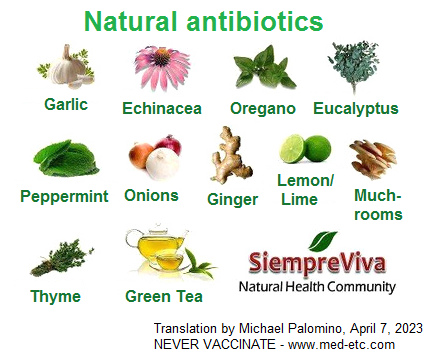
Natural antibiotics: garlic, echinacea, oregano, eucalyptus,
peppermint, onions, ginger, lemons / limes, mushrooms, thyme,
green tea - and missing in the photo: honey and
horseradish [1]
Healing effects of thyme - the list


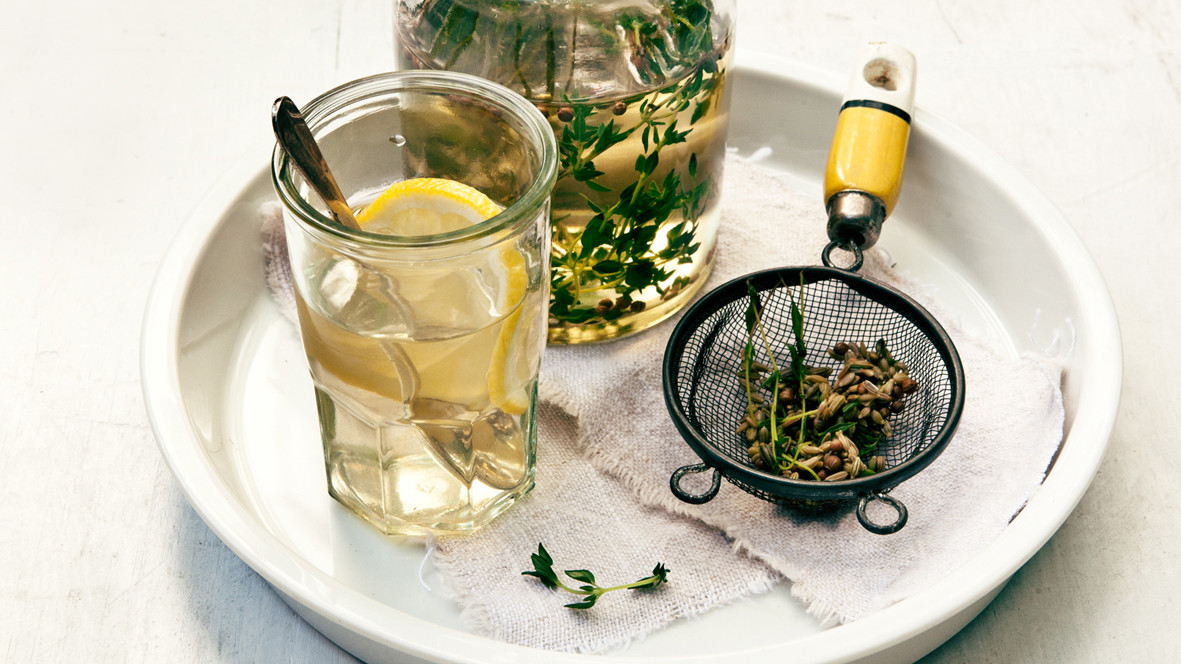
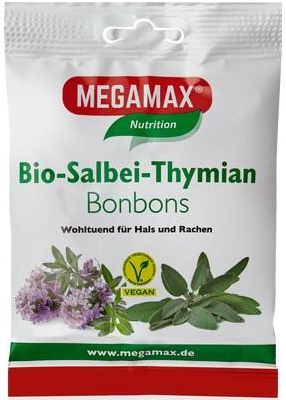
Thyme drops [5] - thyme tea in tea bags [6] - thyme tea [7] -
sage thyme candies [9].
-- antibiotic effect of thyme in the form of teas, pastilles,
syrup, capsules: "Thymol has antiseptic effect, kills
bacteria, viruses and fungi." [web02]
Thyme for the respiratory tract
-- heals the respiratory tract: against cramps
(antispasmodic), expectorant [web01,web02], disinfecting,
reducing pain (analgesic), calming [web01]
-- is healing inflammation of the respiratory tract:
bronchitis, whooping cough, asthmatic complaints [web01],
asthma, shortness of breath, cold, bronchitis, cough, sore
throat, tonsillitis [web02]
-- other inflammations: Inflammation of the mouth: tonsillitis
/ oral mucosa / gum inflammation (gargle thyme tea, draw, take
tincture, place gelatinous thyme ointment) [web02]
-- against bad breath with a "thyme stem" [web02]
Thyme for the gastrointestinal tract
-- is heliang discomfort in the gastrointestinal tract
[web01], is against cramps (antispasmodic) [web02], promotes
digestion (digestive), is calming (soothing) [web01]
Thyme against menstruation pain
-- antispasmodic: reducing menstrual cramps [web02].
Quote: "Thyme drops are recommended for menstrual cramps. Take
these as soon as the discomfort begins, up to 25 drops six
times a day." [web02]
[Menstrual cramps go also away with anise seed chewing 3x a
day and after 1 month they don't come back]
Thyme against inflammation in the body
-- other inflammations: bladder inflammation (cystitis) (drink
thyme tea, take thyme drops) [web02]
Thyme for the skin
-- Skin problems: wound treatment [web01]
-- Skin problems [web01]: Thyme tincture for pimples and acne
[web02].
Thyme for the immune system
-- stimulates the immune system [web02]
Quote: "The essential oils, the bitter substances and the
flavonoids [have] an immune-stimulating effect or support
[...] the immune system in the fight against unwanted
invaders. The immune system in the intestine is also
stimulated by the bitter substances and the secondary plant
compounds directly protect our cells." [web02]
Thyme for rejuvenation
-- Cell protection ([rejuvenation?] through zinc, etc.)
[web02]
Make thyme tea
-- can be bought as tea bags
-- or you can strain the leaves, pour over, let it infuse for
10 min, strain, drink
-- maximum 4 to 5 cups per day [web02]
Contraindications
-- in case of overdose the liver is damaged and the thyroid
gland gets out of balance [web02]
[web01] Thyme (orig. German: Thymian):
https://www.pflanzliche-antibiotika.de/Arzneipflanzen/Beispiele/Thymian.html
[web02] Informative about the plant thyme (orig. German:
Informatives rund um die Pflanze Thymian):
https://www.thymian.info/
The articles
Thyme for respiratory, gastrointestinal and
skin problems [web01]
Thyme [web01]
(orig. German: Thymian) [web01]
https://www.pflanzliche-antibiotika.de/Arzneipflanzen/Beispiele/Thymian.html
[web01]
Summary
-- thyme, lat. Thymus vulgaris, is a semi-shrub from Europe,
up to 50cm high, dark green, the leaves are strongly fragrant,
the flowers are light pink
-- the leaves of thyme have a healing effect with essential
oils (thymol, thujanol, linalool, geraniol and others)
-- forms: as a spice, tea, essential oil, skin oil, tincture
for massage, etc.
Medicinal properties of thyme leaves
-- disinfectant, antispasmodic, expectorant, promoting
digestion (digestive), reducing pain (analgesic), calming
(sedative)
-- against: bronchitis, whooping cough, asthmatic complaints,
gastrointestinal complaints, wound treatment, skin problems.
Thyme with complex effects: respiratory
tract, inflammation, cramps, menstrual complaints,
pimples, acne [web02]
Information about the thyme plant [web02]
(orig. German: Informatives rund um die Pflanze Thymian)
[web02]
https://www.thymian.info/ [web02]
Summary
Names
-- Greek: thymos = lat. thymus = strength or courage
-- names: Thyme, lat. Thymus vulgaris
-- thyme is a dwarf shrub, up to 40cm high, has small,
elliptical leaflets, slightly grayish + finely hairy on
the underside
-- thyme has about 350 species with small differences in
shape, appearance, growth height, ingredients
-- thyme remains long without flowers, then they bloom in
white, pink or purple, is a labiate, similar to lavender
-- Thyme can grow almost everywhere, but especially on
sandy soils and stony slopes, in the Mediterranean area
thyme grows wild just like that (Sp, F, It), also in
Central Europe
-- thyme is known and mentioned since ancient Egypt, as a
medicinal plant and as a plant of sacred rituals, e.g. as
a burial gift, and also in the kitchen
-- thyme has its origins in the Mediterranean, Rome
soldiers are said to have bathed in thyme baths to
strengthen "for courage and strength"
-- in the Middle Ages, the knowledge of thyme was adopted
in France, especially for cooking thyme is aromatic, is in
Italian herbal mixtures, and was long also considered for
"courage and strength" before a military battle
Ingredients of thyme
-- are a large combination with effects from different
sides and thus has a rich, "complex mode of action"
-- factors are the variety of thyme, the origin, the time
of harvesting
-- thyme is used as a monopreparation and in many
combinations
-- ingredients include the following effects: germicidal
antibiotic - antispasmodic - expectorant - stimulates the
immune system
essential oils:
-- essential oil: thymol: "thymol has an antiseptic
effect, kills bacteria, viruses and fungi" - "thymol has
the property, among others, to dissolve stuck mucus, for
example in bronchitis."
-- essential oil: carvacrol
-- essential oils: geraniol, camphor, cineole, linalool,
limonene and menthone.
"The oils are antispasmodic and analgesic. [...] They
account for about 1.5-2% of the plant ingredients."
other ingredients:
-- secondary plant compounds: -- flavonoids (for cell
protection) -- coumarins (for cell protection).
-- Zinc (for cell protection, enzymatic functions, immune
system)
-- resins
-- Salicylates (anti-inflammatory and analgesic)
-- Pentosans (dietary fiber)
-- Stigmasterols (plant sterol, similar to cholesterol,
promotes good HDL cholesterol).
-- Calcium
"In the case of dried spice, the levels are significantly
higher, but the amounts consumed are usually
correspondingly lower."
Healing properties of thyme
-- Thyme is more powerful than many poison pills of the
pharmaceutical industry:
Quote, "Thyme is sometimes clearly superior to many purely
chemical medicines in this field, but in any case it is
equal to them."
-- Thyme against coughs, sore throats (teas, pastilles,
syrup, capsules).
-- Thyme against asthma, shortness of breath, colds,
bronchitis.
Relief for asthma: "Thymol in combination with the
flavones can achieve an improvement exactly here and find
use. [...] Tip: The healing effect is as successful
against asthma as is ginkgo (link)."
-- germicidal and antibiotic: against any infections
(respiratory tract, cystitis, tonsillitis).
Quote: "Thyme can be used as effectively for respiratory
infections as it can be applied against cystitis or
tonsillitis. It is like a gentle herbal antibiotic."
Quote: "Thyme tea can have a direct effect on urinary
tract infection, and fight cystitis in its beginnings."
-- against cramps (antispasmodic): respiratory infections,
menstrual cramps (thyme replaces ibuprofen), digestive
problems.
Quote: "For menstrual cramps, thyme drops are recommended.
Take these as soon as the discomfort starts, up to 25
drops six times a day."
[Menstrual cramps also go away with anise seed: chewing
anise seed 3x a day and after 1 month they don't come
back]
-- expectorant
-- reducing cramps (antispasmodic): respiratory
infections, menstrual cramps (thyme replaces ibuprofen),
digestive problems.
Quote: "For menstrual cramps, thyme drops are recommended.
Take these as soon as the discomfort starts, up to 25
drops six times a day."
[Menstrual cramps also go away this way: with anise seed
chewing 3x a day and after 1 month they don't come back]
-- expectorant
-- stimulates the immune system
Quote: "The essential oils, bitter substances and
flavonoids [have] an immune-stimulating effect or support
[...] the immune system in the fight against unwanted
invaders. Thymol has an antiseptic effect, kills bacteria,
viruses and fungi. The immune system in the intestine is
also stimulated by the bitter substances. And the
secondary plant compounds directly protect our cells."
-- Cell protection (through zinc, etc.)
-- Thyme cures pimples and acne: Thyme tincture can
reduce acne.
Quote: "Acne is caused by a certain strain of bacteria,
the propionibacteria. These are particularly sensitive to
the antibacterial effect of thyme. Especially for people
with sensitive skin, thyme for acne can offer a valuable
alternative to conventional, aggressive agents that often
damage the skin."
-- Thyme heals inflammation in the mouth: tonsillitis /
oral mucosa / gum inflammation.
With the essential oils in water as a gargle solution, as
a tea, as a diluted tincture, as a gelatinous ointment,
with antibacterial, antiviral, and antifungal effects
Quote: "Thyme can be used quite easily in water as a
gargle solution. It can be bought like this. Of course,
you can also drink tea or use it for gargling or dilute a
tincture. Thyme has antibacterial, antiviral and
antifungal effects. Due to the volatility of essential
oils, the effect reaches the entire oral cavity in a very
short time. Therefore, thyme can be used very well for
tonsillitis and, of course, for other inflammations in the
mouth such as inflammation of the gums and oral mucosa. To
prolong the stay of the active ingredient at the site of
action, there are also gelatinous thyme ointments, which
you apply directly to the inflamed area. "
-- Thyme helps against bad breath with a "thyme stem."
Thyme tea
-- can be bought as tea bags
-- you can collect the leaves, pour over, let infuse for
10 min, strain, drink
-- maximum 4 to 5 cups per day.
Contraindications
-- in case of overdose the liver may be damaged and the
thyroid gland may become unbalanced.